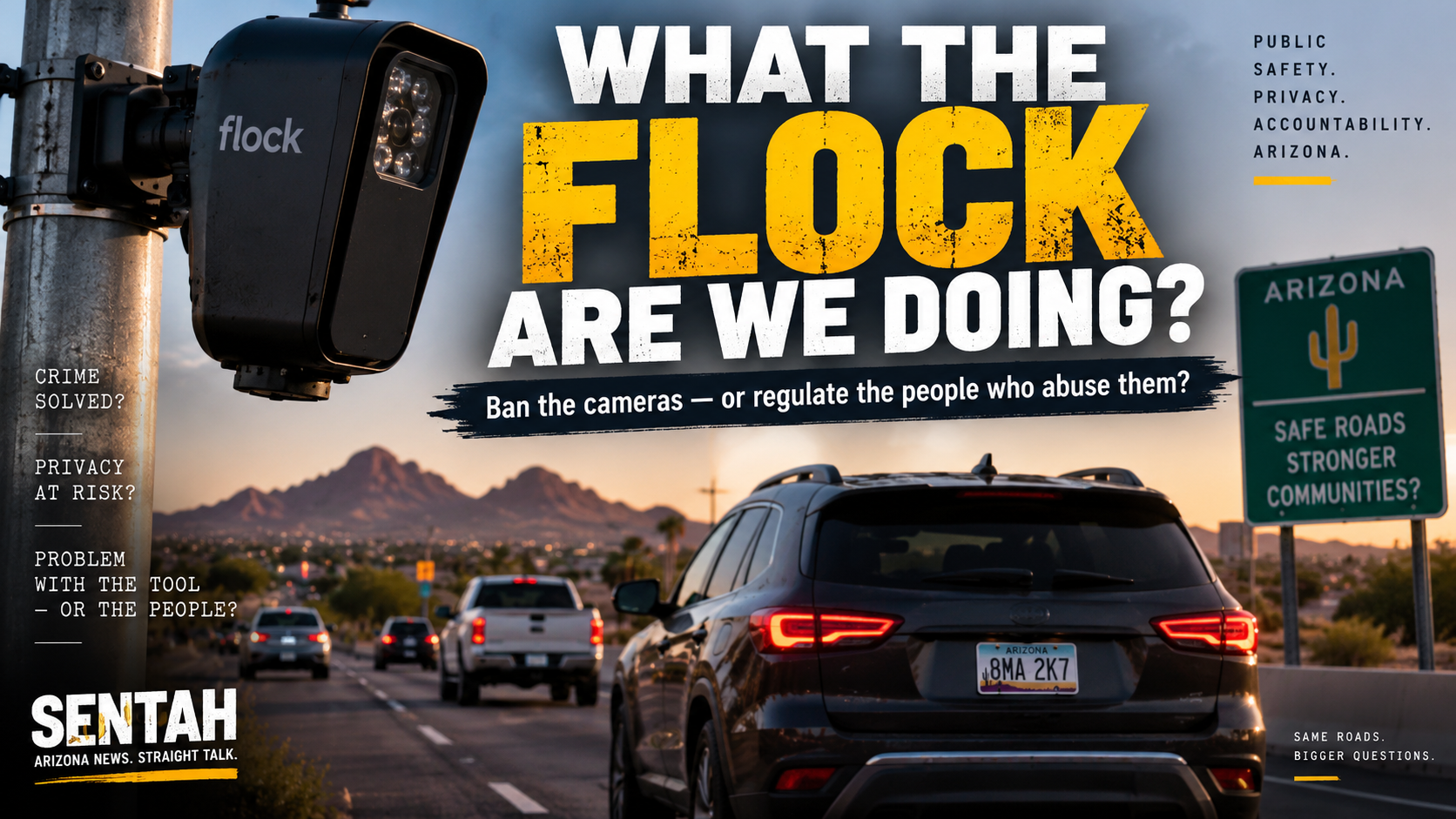
There is a pretty good chance somebody took a picture of your license plate today.
Maybe it was a traffic camera. Maybe somebody’s dashcam caught you. Maybe you committed the unforgivable Arizona sin of driving 64 in the left lane and somebody posted a picture of your car on Facebook to tell the world about it.
And if a police officer was sitting behind you at a red light, your license plate wasn’t exactly a secret to them either.
We live in a country where almost everyone carries a video camera in their pocket. First Amendment auditors deliberately film police officers, government buildings and public spaces. People photograph cars on public roads every day.
Generally speaking, photographing what is plainly visible from a public place isn’t some extraordinary invasion of privacy.
So when the debate over Flock Safety cameras gets reduced to the government took a picture of my license plate, something important is getting lost.
Because that’s not really the hard part of this debate.
What happens to the information after the picture is taken is.
What exactly does a Flock camera see?
Automated license-plate readers, usually called ALPRs, are cameras positioned along roadways that capture information about passing vehicles.
According to the Town of Queen Creek, its system captures the license plate image and characters along with visible characteristics of the vehicle — things like make, model, color and body style — at a particular place and time.
It does not identify the person driving. It doesn’t use facial recognition or biometric identification, and it isn’t continuously GPS-tracking your car.
Taken individually, that doesn’t sound particularly remarkable.
A person standing on the corner could see much of the same thing.
The difference is that the person standing on the corner isn’t standing on hundreds of corners at once.
And they probably aren’t creating a searchable database of what they saw.
That’s where this gets complicated.
The cameras actually work
It would be much easier to argue about Flock cameras if they didn’t accomplish anything.
Unfortunately for simple arguments, they do.
Queen Creek says ALPR information provided leads in more than 2,400 cases during fiscal year 2025-26, including locating stolen or wanted vehicles, helping with missing or endangered-person investigations and identifying vehicles associated with crimes. The town is careful to point out that an ALPR hit is an investigative lead, not proof that somebody committed a crime.
Police Chief Randy Brice told the Queen Creek Town Council last week that its 47 installed readers have assisted in more than 3,000 incidents since 2025. He specifically pointed to road-rage and hit-and-run investigations and cases involving missing or endangered people.
That’s not nothing.
And Queen Creek isn’t alone in saying the technology helps.
Apache Junction says it has used ALPR technology since 2022 to support criminal investigations and public safety. Even after discovering that one of its own officers had abused the system, Police Chief Michael Pooley defended keeping it because of its value in solving crimes and locating missing people.
Which brings us to the other side of this story.
Because that officer really did abuse it.
And yes, the abuse is real
This isn’t a hypothetical argument about what some future police officer might do.
An Apache Junction officer used the system to search for his wife’s vehicle while the couple was having marital problems.
Internal-affairs records obtained by Arizona’s Family Investigates showed that the officer searched for his wife and two dispatchers also accessed the system on his behalf. The officer ultimately resigned; the dispatchers were disciplined.
That’s exactly the kind of use that should make people uncomfortable.
A similar case surfaced in Chandler, where an officer admitted using the system to locate a family member. That officer also resigned.
Arizona Attorney General Kris Mayes has now announced a statewide review of automated license-plate readers, including their effect on privacy and potential Fourth Amendment concerns. And Mayes’ own framing is worth paying attention to.
She isn’t saying the technology has no legitimate purpose.
She says technology can help police prevent and solve crimes and that its use has to be balanced against constitutional and privacy rights.
Both things can be true.
That’s kind of the problem.
Eleven Arizona communities have said enough
According to reporting published Tuesday by KJZZ’s Taylor Griffith, Cottonwood and Payson recently joined the Arizona communities terminating Flock contracts, bringing the statewide total to 11.
For those communities, the concerns about privacy, access and public trust have become enough to pull the plug.
That’s one answer.
Queen Creek just chose another one.
Don’t get the Flock out. Put some rules on it.
Queen Creek hasn’t found misuse of its own ALPR system.
Instead of waiting until it does, the town decided to put additional guardrails around the technology.
Last week, the Queen Creek Town Council unanimously approved an ordinance making knowing misuse of ALPR information a Class 1 misdemeanor.
That distinction matters.
An accidental or inadvertent mistake isn’t what the ordinance targets. Knowing misuse can include accessing the system outside an approved investigation, using the information to stalk, harass or intimidate someone, or selling the information.
And this isn’t just a strongly worded employee handbook.
A Class 1 misdemeanor in Arizona can carry up to six months in jail and a fine of up to $2,500.
In other words:
Use the camera to find a stolen car? That’s your job.
Use it to help find a missing kid? That’s your job.
Use it because you’re wondering where your ex-wife went?
Now we have a very different conversation.
Queen Creek also limits access to trained and authorized personnel, logs searches by individual user accounts and subjects activity to audits. The town says searches must have a documented law-enforcement purpose. Its current system retains data for no more than 30 days unless the information is preserved as evidence.
There are still holes critics can reasonably point to.
KJZZ reported, for example, that while Queen Creek’s police chief says the department does not share its information with federal agencies or permit its use for immigration or reproductive investigations, the ordinance itself does not explicitly prohibit every downstream recipient from sharing information further. The ordinance requires a public audit at least annually.
So passing an ordinance doesn’t magically settle the privacy debate.
But it does give Arizona another model to look at.
The contradiction we probably can’t avoid
We willingly live in an increasingly photographed world.
Ring cameras watch neighborhoods. Dashcams record highways. Businesses record parking lots. Phones record damn near everything.
Then somebody photographs a license plate on a public road and suddenly the conversation can jump straight to constitutional violation.
That’s probably too simple.
But the opposite argument — if you aren’t doing anything wrong, why do you care? — isn’t much better.
Because there is an enormous difference between a camera seeing your car drive past and someone with government access being able to search a large collection of those observations for personal reasons.
The Apache Junction case demonstrated that difference pretty clearly.
The camera wasn’t the one going through marital problems.
A person was.
And a person decided to use a legitimate law-enforcement tool for something it wasn’t intended to do.
So what are we actually trying to solve?
That’s the question Arizona has to answer.
If the technology didn’t work, this would be easy. Take the cameras down.
If nobody had ever abused it, this would be easier too. Keep them up.
Neither is true.
Police have demonstrated legitimate uses for automated plate readers. Officers have also demonstrated that giving human beings access to powerful databases occasionally results in a human being doing something incredibly stupid with them.
So Arizona has a choice.
Get the Flock out of here?
Or keep the technology, strictly limit what can be collected and how long it can be stored, control who can search it, maintain searchable audit trails, restrict sharing — and put some actual teeth behind the rules when somebody abuses it.
Queen Creek has picked the second option.
Eleven other Arizona communities have picked the first.
The cameras aren’t really the only thing Arizona is deciding about anymore.
We’re deciding whether the problem is the tool itself — or what we’re willing to let people do with it.