A group of primary-care clinicians employed by Banner Medical Group in Arizona has voted to unionize.
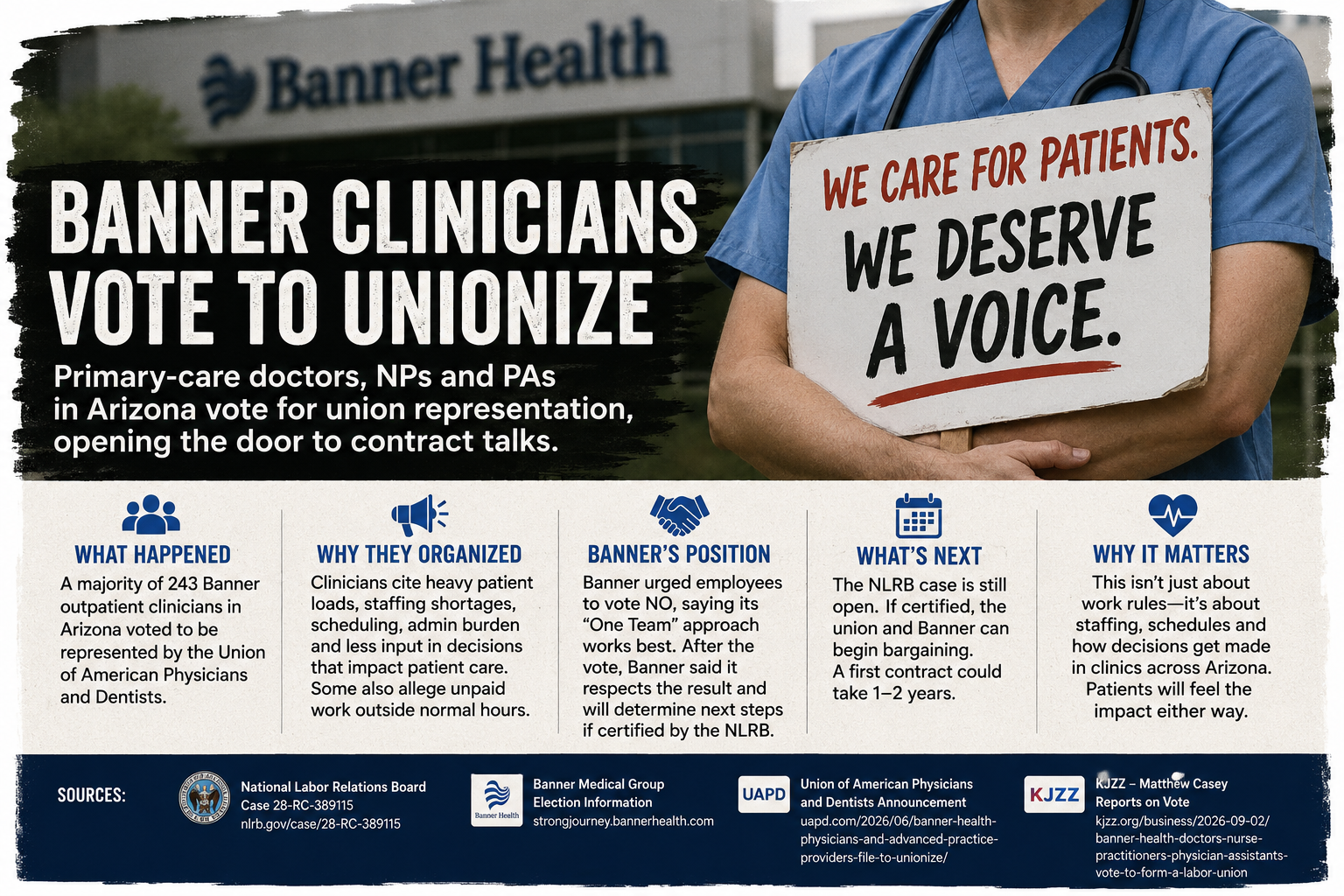
The election covers physicians, nurse practitioners and physician assistants working in Banner outpatient clinics across the state. The National Labor Relations Board lists 243 employees in the bargaining unit, and the case was still open Wednesday evening. (nlrb.gov)
Banner confirmed the result Wednesday.
In a statement to KJZZ, the health system said a majority of participating clinicians voted to be represented by the Union of American Physicians and Dentists. Banner said it respects the outcome and will determine its next steps once the NLRB certifies the results. (kjzz.org)
That vote matters.
But it is not the finish line.
Why did the clinicians organize?
This effort didn’t appear overnight.
When clinicians filed for union representation in June, organizers pointed to concerns about patient loads, staffing, scheduling, administrative work and how much say clinicians have in decisions affecting patient care.
Those are the organizers’ claims. The NLRB has not made findings that Banner violated those standards.
The Union of American Physicians and Dentists said more than 240 clinicians were involved in the organizing effort across 31 clinic locations. The union also says those clinicians collectively serve more than 500,000 patients a year. (uapd.com)
Some clinicians have also said they regularly perform unpaid work outside normal hours.
KJZZ reporter Matthew Casey interviewed Banner clinicians before the election who described concerns about unpaid work, patient loads and reduced clinician input in operational decisions. Those are allegations from the clinicians Casey interviewed, not independently established findings against Banner. (kjzz.org)
Banner opposed the union
Banner was clear about that before the ballots were counted.
The health system created a website for the election and encouraged eligible employees to vote no. Banner argued that its existing “One Team” approach allows employees and leadership to work together directly without a union acting as an intermediary. (strongjourney.bannerhealth.com)
After the vote, Banner took a more measured tone.
Rather than challenging the clinicians’ right to organize, the company said it respects the result and will determine what comes next if the NLRB certifies it. (kjzz.org)
What happens now?
The immediate answer is: not much changes overnight.
The NLRB case remains open. Certification is the next important step. (nlrb.gov)
If the result is certified and no legal challenge changes it, Banner and the union can begin collective bargaining.
That process can be slow.
A first contract has to be negotiated from scratch, and the two sides may disagree over staffing, scheduling, workloads, compensation and other working conditions.
A union organizer previously told KJZZ that reaching a first contract can take one to two years. (kjzz.org)
So Wednesday’s vote answered one question:
Do these clinicians want union representation?
A majority of participating voters said yes.
The harder questions are still ahead.
This is also about patient care
That is what makes this more than a standard labor story.
The people involved are not debating only paychecks and workplace rules. They are also talking about appointment volume, staffing, paperwork and how much time clinicians have to actually care for patients.
That doesn’t automatically mean the union is right.
Banner’s position is that direct collaboration between clinicians and leadership works better than adding a third party to that relationship.
Union supporters argue the opposite: that collective bargaining gives clinicians more leverage when decisions about workloads and patient care are being made.
Both sides are talking about the same thing in the end.
How should a large healthcare system be run, and who gets a meaningful say in those decisions?
The vote tells us where a majority of participating clinicians landed.
It does not yet tell us what patients will notice.
That’s the part worth watching
Will staffing levels change?
Will clinicians get more control over schedules or patient loads?
Will appointment access improve, worsen or stay about the same?
Will labor costs rise?
Will Banner change any of its existing policies before a contract is even reached?
Those are the questions that will tell us whether this vote changes anything beyond the bargaining table.
For now, the important fact is simpler:
Hundreds of Banner primary-care clinicians in Arizona have decided they want a union representing them.
The election is over.
The real negotiation is just beginning.