At halftime Sunday, the Arizona Cardinals had every reason to feel pretty good about themselves. The defending Super Bowl champions were in their building. Seattle had already hit them with an 82-yard touchdown. Arizona’s offense wasn’t exactly lighting up the scoreboard.
And somehow, after 30 minutes, it was 7-7.
Then halftime ended.
Apparently, Arizona’s offense didn’t get the memo.
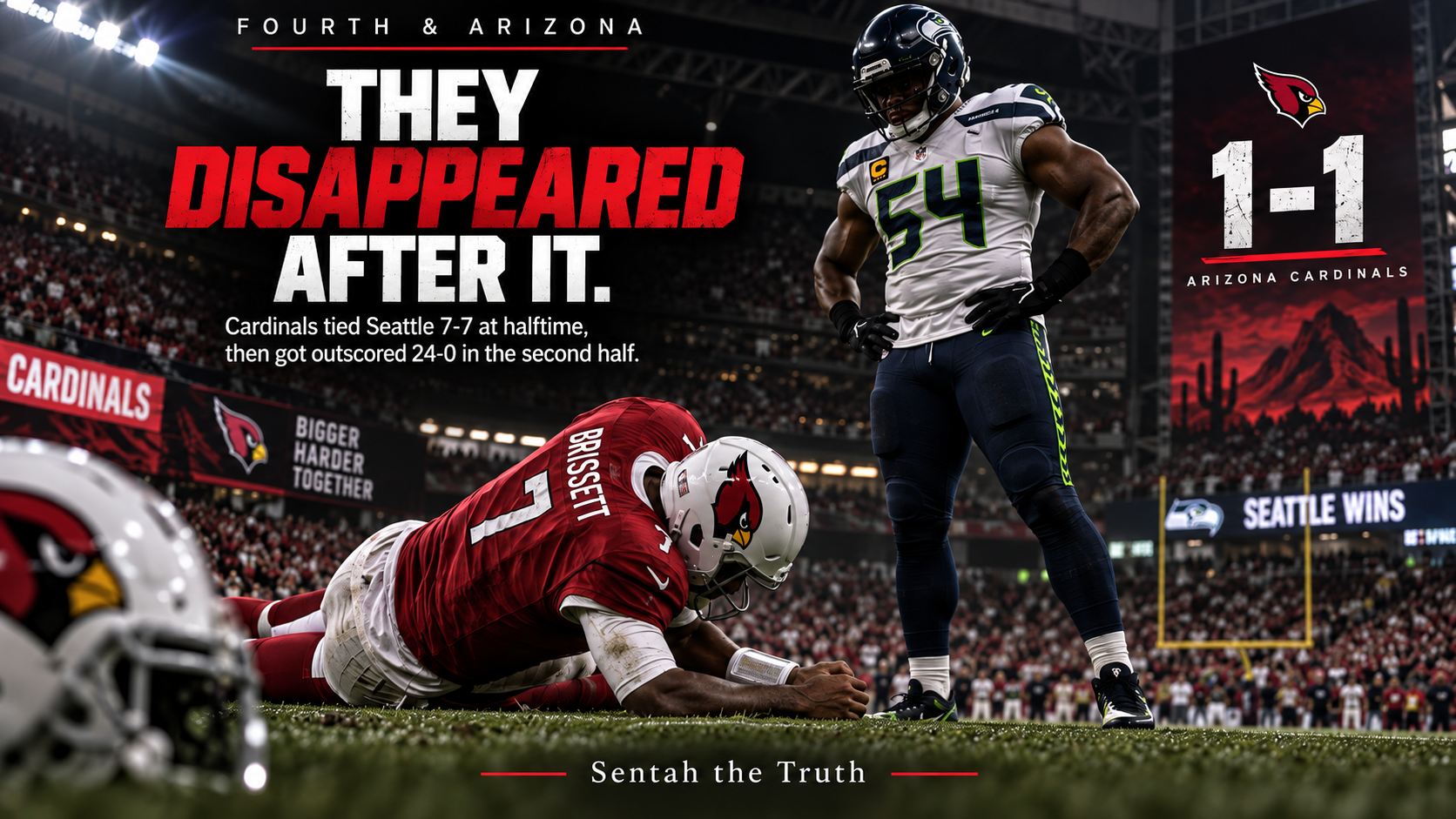
Seattle scored 24 unanswered points in the second half and walked out of State Farm Stadium with a 31-7 win. The Cardinals walked out 1-1 with a very different question than the one they had after beating the Chargers a week earlier:
Which Cardinals team is this?
Because Sunday gave us two of them.
For 30 Minutes, Arizona Hung Around
Nobody is going to frame the first half and hang it in the Louvre, but Arizona was still standing.
Trey McBride’s two-yard touchdown catch tied the game on the first play of the second quarter. Late in the half, the Cardinals defense stopped Seattle at the goal line and kept the game tied going into the locker room.
Against the defending champions, you take 7-7 at halftime every damn time—especially when you haven’t played particularly well.
Then Seattle came back onto the field and Arizona didn’t have an answer.
Jaxon Smith-Njigba caught his second touchdown early in the third quarter. Seattle added a field goal. Smith-Njigba scored again in the fourth, and by then the close football game Arizona had taken into halftime was gone.
He finished with nine catches, 155 yards and three touchdowns.
And remember who was throwing him the football.
Drew Lock.
Not Sam Darnold.
Seattle’s backup quarterback completed 19 of 26 passes for 235 yards, three touchdowns and no interceptions. So we can throw the “but they played the Super Bowl champions” excuse away fairly quickly.
Arizona played the Super Bowl champions without their starting quarterback.
And got beat by 24.
151 Yards
That number tells the story better than almost anything I can write.
151 total yards.
I don’t care who you are playing. That isn’t an offense.
That’s an alibi.
Arizona ran only 47 offensive plays, converted three of 12 third downs and finished with 10 first downs.
Jacoby Brissett completed 17 of 28 passes for 95 yards.
Ninety-five.
His longest completion went nine yards.
McBride caught eight passes, which sounds pretty good until you get to the next number: 41 yards. Jeremiyah Love led the Cardinals in rushing with 29.
And Marvin Harrison Jr.?
No catches.
After one reception in Week 1.
Last week, we were willing to call one catch something to watch. Two games in, I think we can remove the “something.”
Getting Harrison involved is now a problem the Cardinals need to solve.
Arizona Never Made Seattle Uncomfortable
The most frustrating part might not even be the score. It was the way the game ended.
Seattle’s final scoring drive lasted 16 plays, covered 70 yards and consumed 10 minutes and 14 seconds.
Think about that for a second.
The Cardinals were already losing badly, desperately needed the football back, and Seattle essentially told them:
No.
The Seahawks took the ball with more than 11 minutes remaining and didn’t give it back until 1:11 remained, after A.J. Barner had scored another touchdown.
That wasn’t a two-minute drill.
That was eviction paperwork.
Seattle finished with 381 yards, 23 first downs and more than 36 minutes of possession. Arizona had the ball for 23:27.
By the end, Seattle wasn’t even trying to create explosive plays. It was trying to finish the afternoon.
Arizona couldn’t stop them from doing that either.
The Cardinals Know What Happened
Mike LaFleur didn’t try to dress it up afterward. He described the second half as having “no fluidity” and talked about the offense failing to do what he calls the “ordinary extra.”
That actually describes Sunday pretty well.
Arizona didn’t need magic. They didn’t need Brissett to suddenly become Josh Allen. They needed first downs. They needed sustained drives. They needed to give their defense more than a couple minutes before sending it right back onto the field.
They needed ordinary football.
They didn’t get it.
Safety Andrew Wingard summed up the lesson a little more directly Monday:
“The league will humble you quick.”
Yep.
Consider Arizona humbled.
Linebacker Zaven Collins also made it clear the frustration went beyond one ugly afternoon because the Cardinals believe they have a good football team.
That belief is going to get tested quickly.
One Loss Isn’t a Season
Here is where I’m not joining the panic crowd.
Arizona is 1-1.
That’s it.
They went to Los Angeles in Week 1 and convincingly beat the Chargers 26-14. One week later, they got their ass kicked by Seattle.
Both things happened.
Neither should be ignored.
If Week 1 was evidence that Mike LaFleur’s Cardinals could be better than expected, Week 2 was evidence that improvement and consistency are two very different things.
Seattle defensive lineman Leonard Williams described the Seahawks’ defensive mentality as wanting to play like a “boa constrictor.”
On Sunday, that is pretty much what happened.
Arizona stayed alive for a half.
Seattle squeezed.
Eventually, the Cardinals stopped moving.
Now Comes the Part That Matters
Bad football games happen. Even good teams occasionally look terrible.
What matters now is whether Sunday was simply one of those games or whether Seattle exposed something Arizona is going to spend the next several months trying to fix.
Can Brissett push the ball farther than nine yards? Can Harrison become part of this offense? Can Arizona stay on the field on third down? Can the running game give LaFleur something to build around?
And when another good team punches them in the mouth after halftime, can they punch back?
We don’t know yet.
That’s why Week 3 suddenly became a lot more interesting.
The Cardinals are 1-1.
Not dead. Not contenders. Just 1-1.
But Sunday made one thing pretty clear:
Whatever optimism Arizona earned in Los Angeles, they’re going to have to earn it all over again.