America created extraordinary wealth over the past generation. But wages, homes, stocks, retirement accounts and businesses did not grow — or get distributed — the same way. Here’s how owning assets increasingly separated those building wealth from those trying to catch up.
In Part One of “Who Owns America?” we looked at the numbers.
America is extraordinarily wealthy.
The harder question is why so much of that wealth ended up concentrated near the top.
There is no single culprit.
It wasn't one president, one political party, one tax cut, one recession or one generation suddenly becoming greedy.
The story is more structural than that.
Over several decades, the American economy increasingly rewarded something different from simply earning a paycheck:
Owning things.
Homes.
Stocks.
Retirement accounts.
Businesses.
Real estate.
Assets that could increase in value while their owners slept.
That distinction — between earning income and owning appreciating assets — helps explain a remarkable change in American wealth.
THE COUNTRY GOT MUCH RICHER
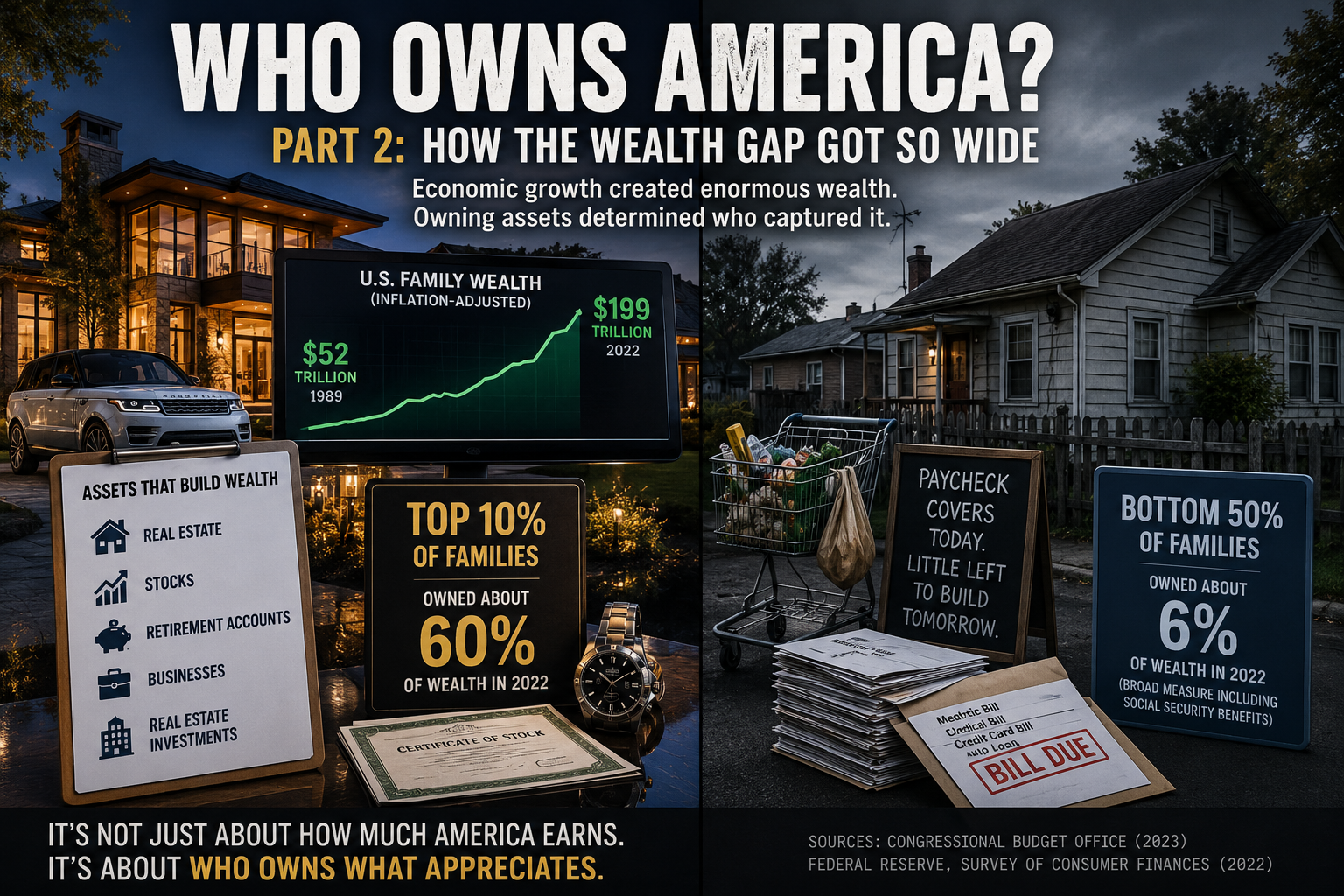
According to the Congressional Budget Office, inflation-adjusted family wealth in the United States increased from about $52 trillion in 1989 to roughly $199 trillion in 2022.
America didn't run out of wealth.
It created an enormous amount of it.
But those gains weren't distributed evenly.
In 1989, families in the wealthiest 10 percent held about 56 percent of total family wealth.
By 2022, their share had increased to about 60 percent.
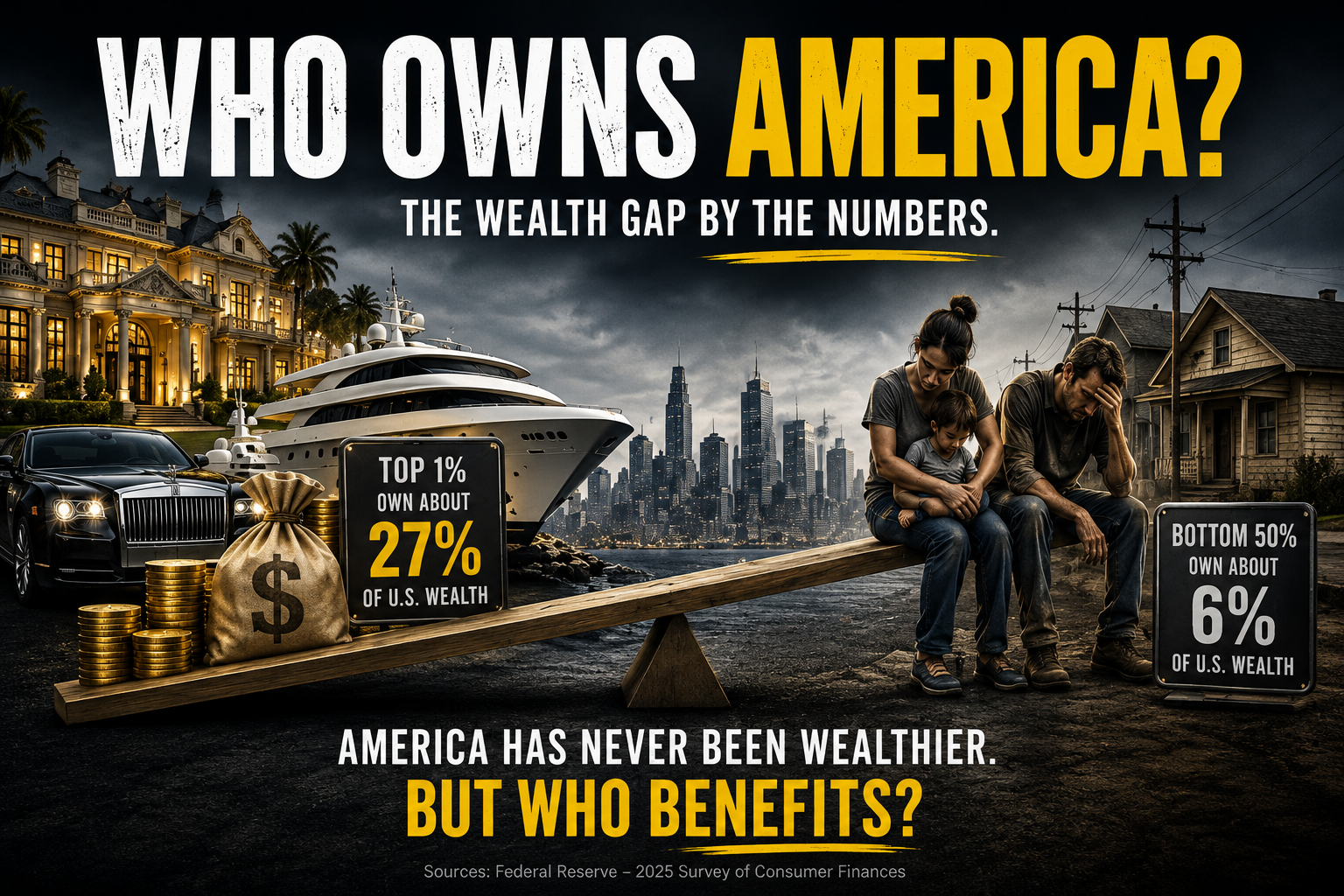
The top 1 percent went from holding approximately 23 percent to 27 percent.
Meanwhile, the bottom half of American families held roughly 6 percent in both years under the CBO's broad measure, which includes the estimated value of future Social Security benefits.
That last detail matters.
If Social Security is excluded and we look more narrowly at marketable assets, wealth is even more concentrated.
So how did we get here?
THE PAYCHECK STOPPED TELLING THE WHOLE STORY
For much of the postwar era, economic productivity and worker compensation moved relatively closely together.
When American workers produced more value per hour, typical worker compensation generally increased alongside it.
Beginning around the late 1970s, those lines began separating.
Economic Policy Institute estimates show productivity has risen far faster than compensation for typical production and nonsupervisory workers since 1979.
There are legitimate debates over exactly how that comparison should be measured and which policies contributed most.
But the broader point is difficult to dispute:
Economic growth alone does not guarantee that workers' paychecks rise at the same rate as the value being produced across the economy.
And wages matter enormously because wages are where most families begin accumulating wealth.
You earn money.
You pay your bills.
If something remains, you save or invest it.
But once someone already owns significant assets, another engine begins working.
THE ASSET ENGINE
Imagine two families.
Both work.
Both receive raises.
But Family A owns a house, retirement accounts and stocks.
Family B rents and has little invested outside a checking or savings account.
Now home prices rise.
Stocks rise.
Family A hasn't simply earned more money.
Its existing wealth has produced additional wealth.
Family B may receive exactly the same percentage raise at work, but it doesn't participate nearly as much in those asset gains.
Do that for five years.
Then ten.
Then thirty.
The difference compounds.
This isn't hypothetical.
Federal Reserve data from 2022 show that 95 percent of families in the highest tenth of the income distribution owned stocks directly or indirectly.
Among families in the bottom half, only 34 percent did.
Stock ownership has broadened considerably through retirement accounts and other investments — 58 percent of American families held stock directly or indirectly in 2022.
But participation and the amount owned remain dramatically different across the income distribution.
When the stock market climbs, therefore, millions of middle- and working-class Americans absolutely benefit.
But people who already own much larger portfolios benefit much more.
HOUSING WORKS THE SAME WAY
For generations, homeownership has been one of America's primary wealth-building mechanisms.
You buy a house.
You gradually pay down the mortgage.
If the home's value increases, your equity grows.
The Federal Reserve found that about two-thirds of families owned their primary residence in 2022.
Between 2019 and 2022 alone, the median value of primary residences among homeowners increased substantially.
That was fantastic news for people who already owned homes.
It was considerably less helpful to people trying to buy their first one.
The same rising price that increases an owner's net worth increases the price of admission for the renter trying to become an owner.
By 2022, the Federal Reserve found the median home's value exceeded 4.6 times median family income, a record in its survey.
This creates another compounding divide.
Homeowners benefit when housing appreciates.
Would-be homeowners face a larger hurdle to get onto the same escalator.
BUSINESS OWNERSHIP ADDS ANOTHER LAYER
Privately held businesses are another major source of wealth.
In 2022, about 20 percent of American families owned a privately held business under the Federal Reserve's broad definition of business ownership.
But again, ownership was uneven.
About 14 percent of families in the bottom half of the income distribution owned businesses, compared with nearly half of families in the top income decile.
And the value of those businesses varies enormously.
The median value of business equity among families holding it was about $90,000 in 2022.
The average was more than $1.6 million.
That enormous gap between the median and average tells us something important:
A relatively small number of extraordinarily valuable businesses pull the average sharply upward.
RETIREMENT CHANGED TOO
The way Americans prepare for retirement also changed.
Traditional defined-benefit pensions became less common while defined-contribution accounts such as 401(k)s became increasingly important.
That shift gave millions of workers direct ownership of financial assets.
That's a real wealth-building opportunity.
But it also means outcomes increasingly depend on whether workers have access to retirement plans, participate in them, contribute enough and have enough income left over to invest.
In 2022, just over two-thirds of working-age families participated in retirement plans.
Participation was not evenly distributed across income groups.
Once again, the same pattern appears:
Owning assets creates opportunities for those assets to generate additional wealth.
Having little left to invest makes catching up harder.
THEN COMPOUNDING TAKES OVER
This may be the most important part of the entire story.
Wealth doesn't merely accumulate.
It compounds.
Suppose someone has $10,000 invested and earns a hypothetical 7 percent return.
That's $700.
Someone with $1 million earning the same 7 percent receives $70,000.
Neither investor necessarily worked harder that year.
Neither received a better percentage return.
One simply began with more capital.
Repeat that process year after year and the absolute gap can grow even if both investors receive identical percentage returns.
That is the mathematics of compounding.
It isn't inherently sinister.
It's also one of the primary ways ordinary Americans build retirement security.
But it means an economy with unequal starting levels of asset ownership can produce increasingly unequal dollar outcomes even when the same investments are available to everyone.
WHAT ABOUT TAXES?
Taxes are part of this story, but they shouldn't be turned into a slogan.
Federal tax policy has changed repeatedly over the past several decades under Republican and Democratic governments.
Different forms of income are also taxed differently.
Wages are generally taxed as they are earned.
Investment gains generally aren't taxed until an asset is sold, and qualifying long-term capital gains can face different rates than ordinary income.
Retirement accounts can receive tax advantages designed to encourage saving.
Homeownership receives its own collection of tax preferences.
Business ownership introduces still more complexity.
Reasonable people can argue about whether those policies encourage investment, unfairly advantage existing