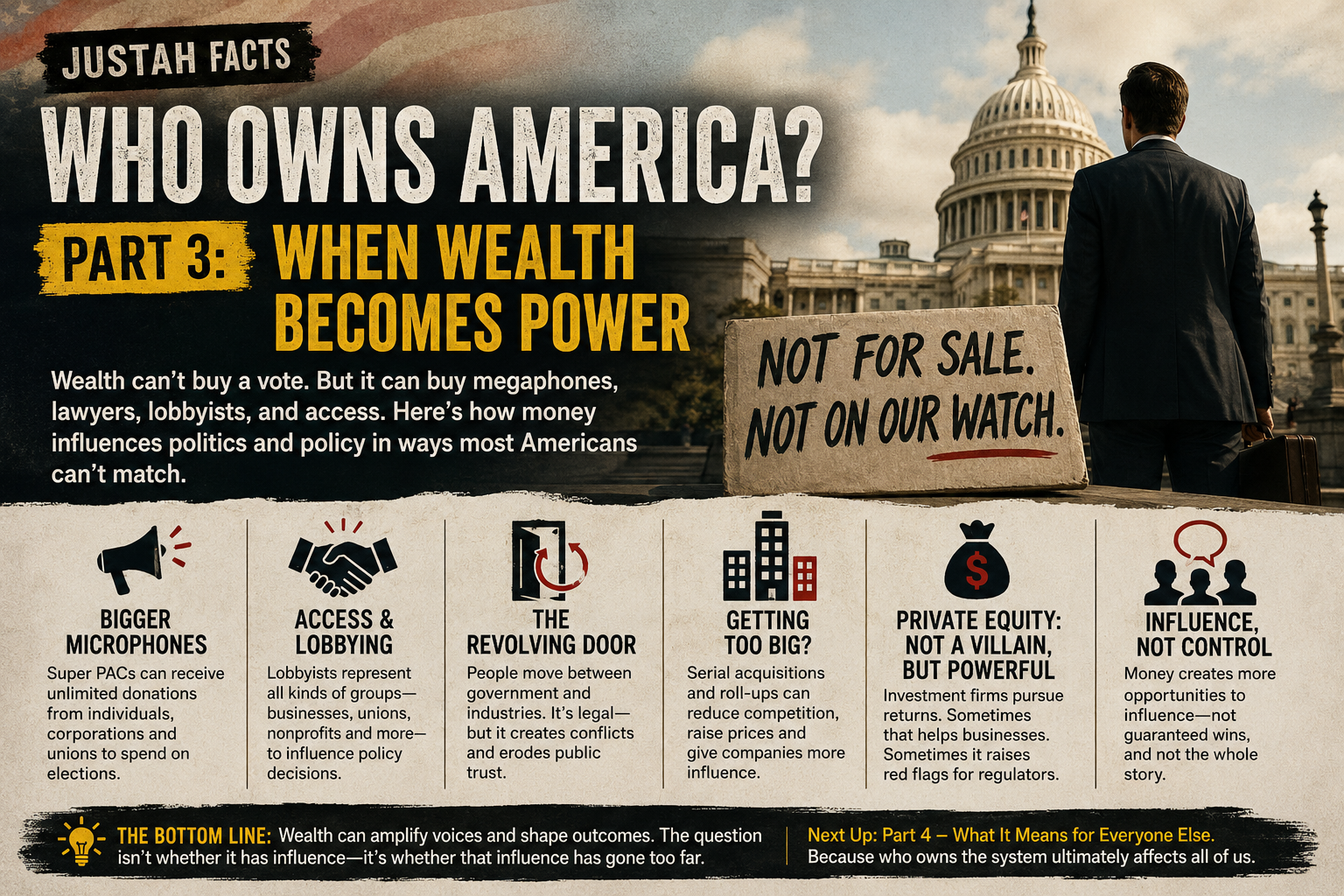
Federal campaign-finance rules allow Super PACs to accept unlimited contributions from individuals, corporations, unions and other political committees, provided their spending remains legally independent of candidates. Federal records also show extensive movement between government and regulated industries, including a GAO review that identified roughly 1,700 former senior Defense Department or acquisition officials employed by 14 major defense contractors after leaving government. Federal antitrust agencies have also examined serial acquisitions and healthcare roll-ups because concentrated economic power can affect competition, prices and policy.
WHO OWNS AMERICA? PART 3
When Wealth Becomes Power Money can buy a house, a business or a stock portfolio. It can also buy something harder to measure: Access.
Sentah the Truth Editorial DeskSeptember 3, 2026
The Claim
Wealth gives wealthy Americans and large organizations more influence over American politics and public policy.
What We Found
The evidence supports that claim — with an important limit. Wealth can buy far more political advertising, Super PAC spending, professional lobbying, advocacy infrastructure and access to policymakers than most Americans could ever afford. But money does not automatically buy votes, guarantee political outcomes or prove corruption.
The Evidence
The Context
Political participation is not inherently improper. Lobbying is legal, campaign spending is protected political activity, and people with government experience are allowed to work in private industry subject to applicable restrictions. Unions, nonprofits and advocacy organizations use many of the same tools as corporations and wealthy individuals. The evidence shows unequal capacity to influence — not proof that wealthy Americans secretly control government or that every favorable policy outcome was purchased.
Verdict
Mostly True
That does not mean wealthy Americans secretly control the government. It does not mean every campaign contribution purchases a vote, or that every lobbyist walks into Congress carrying a check and walks out carrying a new law.
Reality is considerably less cinematic.
But America has built perfectly legal systems through which people, corporations, unions and organizations with substantial financial resources can spend enormous amounts trying to influence who gets elected, which issues receive attention and how government writes its rules.
So the third question in our Who Owns America? series is different from the first two.
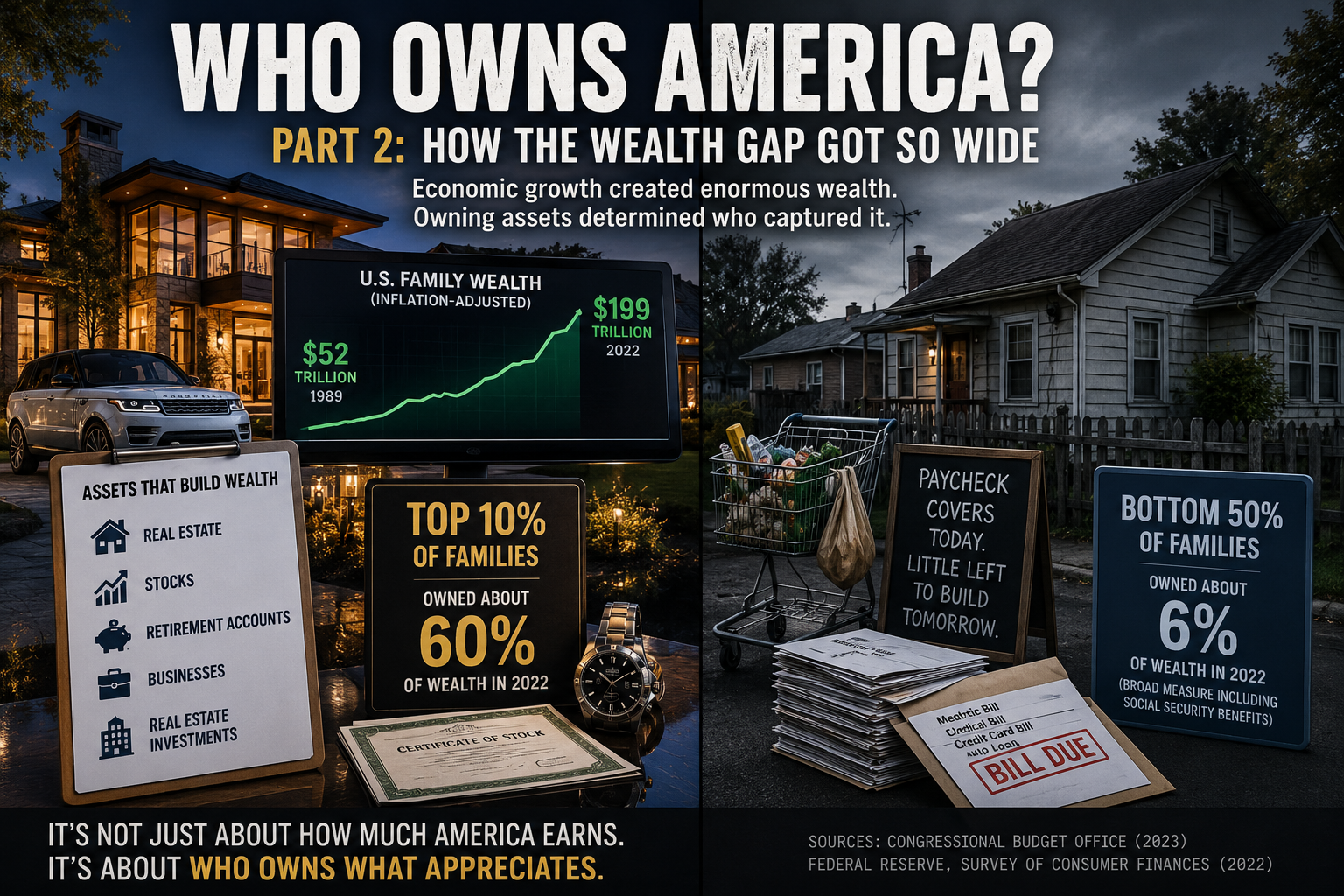
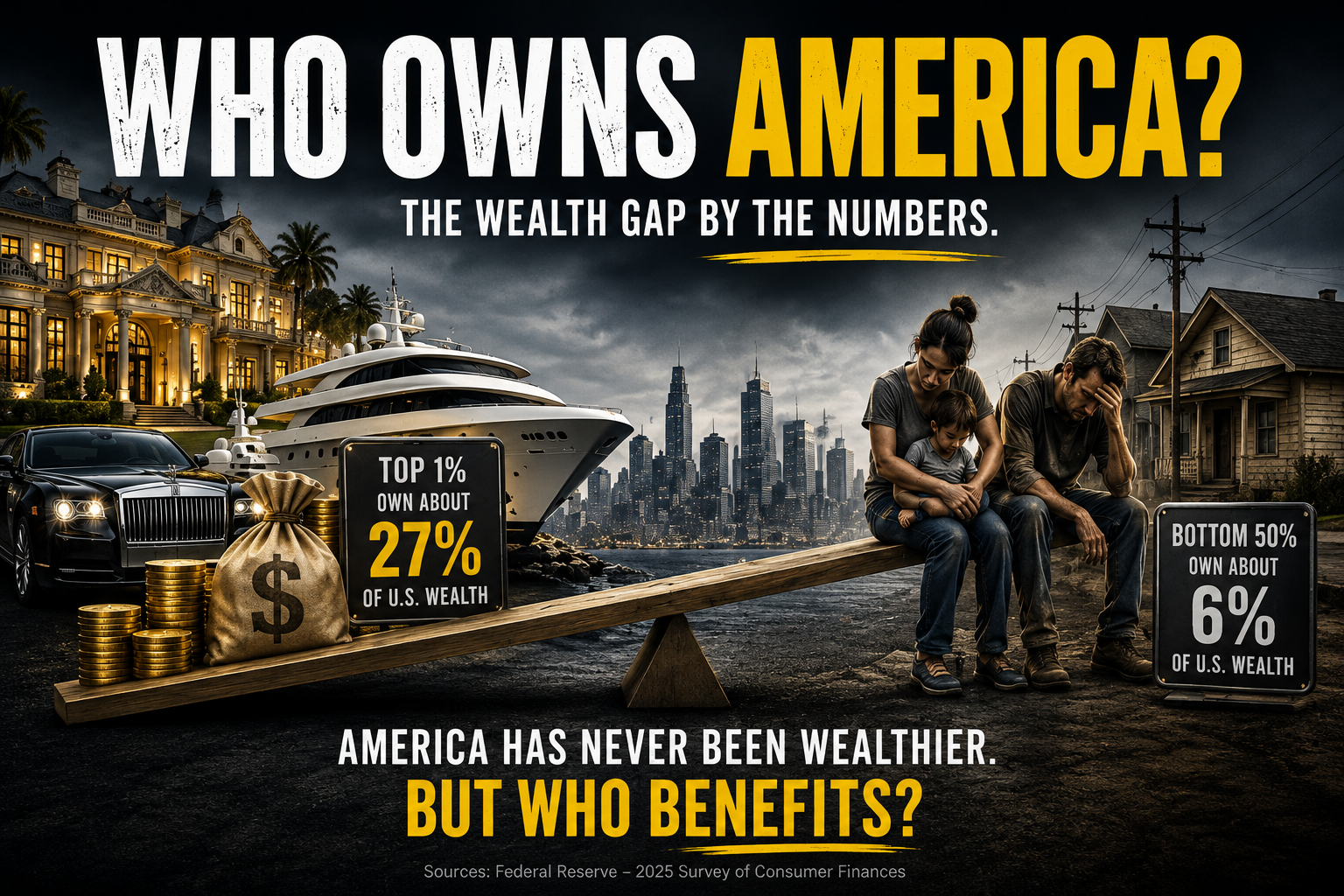
We already looked at who owns the wealth and how that wealth became so concentrated.
Now we ask:
When does wealth become power?
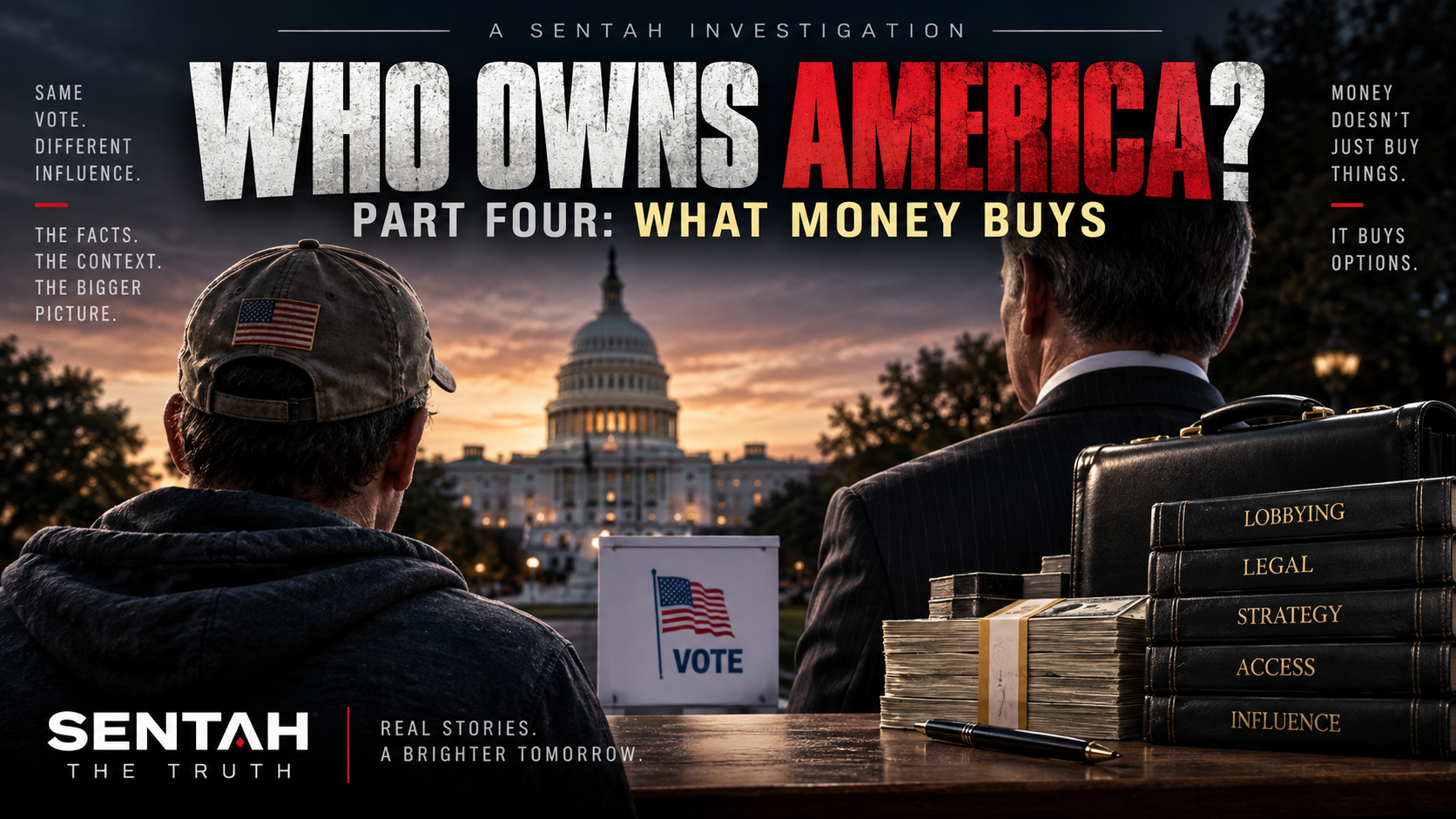
MONEY DOESN’T BUY A VOTE. IT BUYS A BIGGER MICROPHONE.
Start with an important distinction.
Americans face limits on how much they can contribute directly to federal candidates. For the 2025–26 election cycle, an individual can give a federal candidate committee $3,500 per election.
But that is not the entire campaign-finance system.
Super PACs operate differently.
The Federal Election Commission says these independent-expenditure-only committees can accept unlimited contributions from individuals, corporations, labor organizations and other political committees.
They cannot simply hand that unlimited money to a candidate. Their expenditures are legally required to remain independent rather than coordinated with the candidate.
That distinction matters.
Giving $10 million to a Super PAC supporting a candidate is not legally the same thing as giving the candidate $10 million.
But $10 million can still purchase an extraordinary amount of advertising, organizing and political messaging intended to help one candidate or hurt another.
That creates an obvious difference in political capacity.
A person with $50 can participate.
A person with $50 million can participate differently.
That does not prove the second person controls the politician.
It does establish that wealth can purchase considerably more political speech.
THE RULES CHANGED
The modern Super PAC system grew from a series of court decisions in 2010.
In Citizens United v. Federal Election Commission, the Supreme Court struck down restrictions on independent corporate political expenditures. Later that year, the federal appeals court in SpeechNow.org v. FEC concluded that individuals could make unlimited contributions to organizations making only independent expenditures.
The Federal Election Commission subsequently established how independent-expenditure-only committees could operate.
The principle behind the distinction is fairly straightforward.
Money given directly to candidates can create corruption concerns, so direct contributions remain limited.
Independent political spending receives considerably greater First Amendment protection.
Whether that distinction works the way its defenders intended remains one of the central arguments in American campaign-finance law.
But we don’t have to resolve that argument to establish something important:
The amount of money a wealthy person or organization can legally spend trying to influence an election can be dramatically greater than what an ordinary voter can realistically spend.
That isn’t proof of political control.
It is a difference in scale.
And scale matters.
THEN THERE IS LOBBYING
Elections are only one doorway into government.
Once officials are elected, businesses, unions, advocacy organizations, nonprofits, professional associations and countless other groups try to influence public policy through lobbying.
Lobbying itself is not corruption.
And corporations aren’t the only ones doing it.
Environmental organizations lobby.
Disability organizations lobby.
Labor unions lobby.
Gun-rights organizations lobby.
Gun-control organizations lobby.
Technology companies lobby.
Healthcare companies lobby.
Consumer organizations lobby.
Sometimes lobbyists are explaining complicated subjects to lawmakers who cannot possibly be experts in everything they regulate.
Sometimes organizations are aggressively advocating for rules that would benefit them financially.
Those things can even happen at the same time.
The difficult question isn’t whether lobbying should exist.
It’s whether everyone has comparable access to it.
A family worried about a Medicaid cut can call a congressional office.
A major healthcare organization can employ a professional government-affairs team whose full-time job is understanding legislation, maintaining relationships with policymakers and advocating for the organization’s interests.
Both have a voice.
They don’t necessarily have the same-sized microphone.
THE REVOLVING DOOR
There is another route between economic and government power that receives less attention.
People move between government and the industries government regulates or buys from.
It’s commonly called the revolving door.
Again, movement itself proves nothing improper.
Someone who spent 25 years understanding defense procurement may naturally be valuable to a defense company.
Someone who understands financial regulation may naturally be valuable to a bank.
Expertise has value.
But the arrangement creates enough potential for conflicts of interest that federal law places restrictions on certain activities after government employment.
The Government Accountability Office examined this issue at the Department of Defense.
GAO looked at 14 major defense contractors and found they employed approximately 1,700 former senior civilian and military officials or acquisition officials who had left DOD between 2014 and 2019.
GAO did not conclude that those 1,700 people were corrupt.
That’s important.
Its report discussed the restrictions already intended to prevent conflicts of interest while also recognizing that movement between senior government positions and companies doing business with the government can create conflicts and affect public confidence.
A potential conflict is not evidence of corruption.
But pretending the potential conflict doesn’t exist wouldn’t be honest either.
WHEN COMPANIES GET BIGGER
Political power isn’t limited to elections and lobbying.
Market power matters too.
Imagine one company buying competitor after competitor.
Each acquisition might look relatively small on its own. But after enough purchases, one company can become a major force in a market.
In 2024, the Federal Trade Commission and Justice Department opened an inquiry specifically into these serial acquisitions, sometimes called roll-ups.
The agencies noted that individual transactions can fall below thresholds requiring federal antitrust notification even though a long series of acquisitions may eventually give one company significant control within a market.
Healthcare provides an especially important example.
Federal antitrust officials have warned that healthcare roll-ups can potentially reduce competition, which can affect prices, quality and choices available to patients.
That doesn’t mean every acquisition harms consumers.
Companies merge for legitimate reasons. Consolidation can create efficiencies, expand services or keep struggling businesses alive.
But economic concentration can change the negotiating balance among companies, workers, customers and government.
At sufficient scale, economic power becomes something government itself has to respond to.
PRIVATE EQUITY ISN’T A SYNONYM FOR EVIL
Private equity has become an easy political villain.
That makes precision especially important.
Private-equity firms invest in companies with the goal of producing returns for their investors.
That can mean providing capital, restructuring businesses, improving operations or combining companies.
It can also involve debt, aggressive cost-cutting and acquisition strategies that have attracted government scrutiny.
In healthcare, the FTC, Justice Department and Department of Health and Human Services jointly sought information about private-equity and corporate transactions that could increase consolidation and affect patients, workers and taxpayers.
That inquiry is not proof that private equity is inherently harmful.
It demonstrates something more useful for this discussion:
When enough capital becomes concentrated behind an investment strategy, its effects can become large enough to become a matter of public policy.
SO, DO THE RICH CONTROL AMERICA?
The evidence doesn’t justify something that simple.
Money does not guarantee an election victory.
Lobbyists don’t win every fight.
Corporations lose court cases, regulatory battles and political campaigns.
Billionaires disagree with one another politically.
Companies compete against one another.
Labor unions and advocacy organizations use many of the same political tools.
And voters remain perfectly capable of throwing heavily funded candidates out of office.
But dismissing the influence of wealth altogether would require ignoring structures sitting in plain sight.
Money can buy political advertising.
Money can finance Super PACs.
Money can employ professional lobbyists.
Money can fund think tanks and advocacy organizations.
Money can purchase companies and consolidate markets.
Money can hire people with deep experience inside government.
None of those things, individually, proves corruption.
Together, however, they establish something more modest — and more defensible:
Wealth creates opportunities to influence American political and economic life that most Americans simply cannot purchase at the same scale.
Whether that influence has become excessive is ultimately a political judgment.
But its existence isn’t imaginary.
And that brings this investigation to its final question.
Wealth concentration is interesting as an economic statistic.
It matters much more if it changes the opportunities available to everybody else.
Part 4: What It Means for Everyone Else.
Sources
“Just the facts, Jack.”