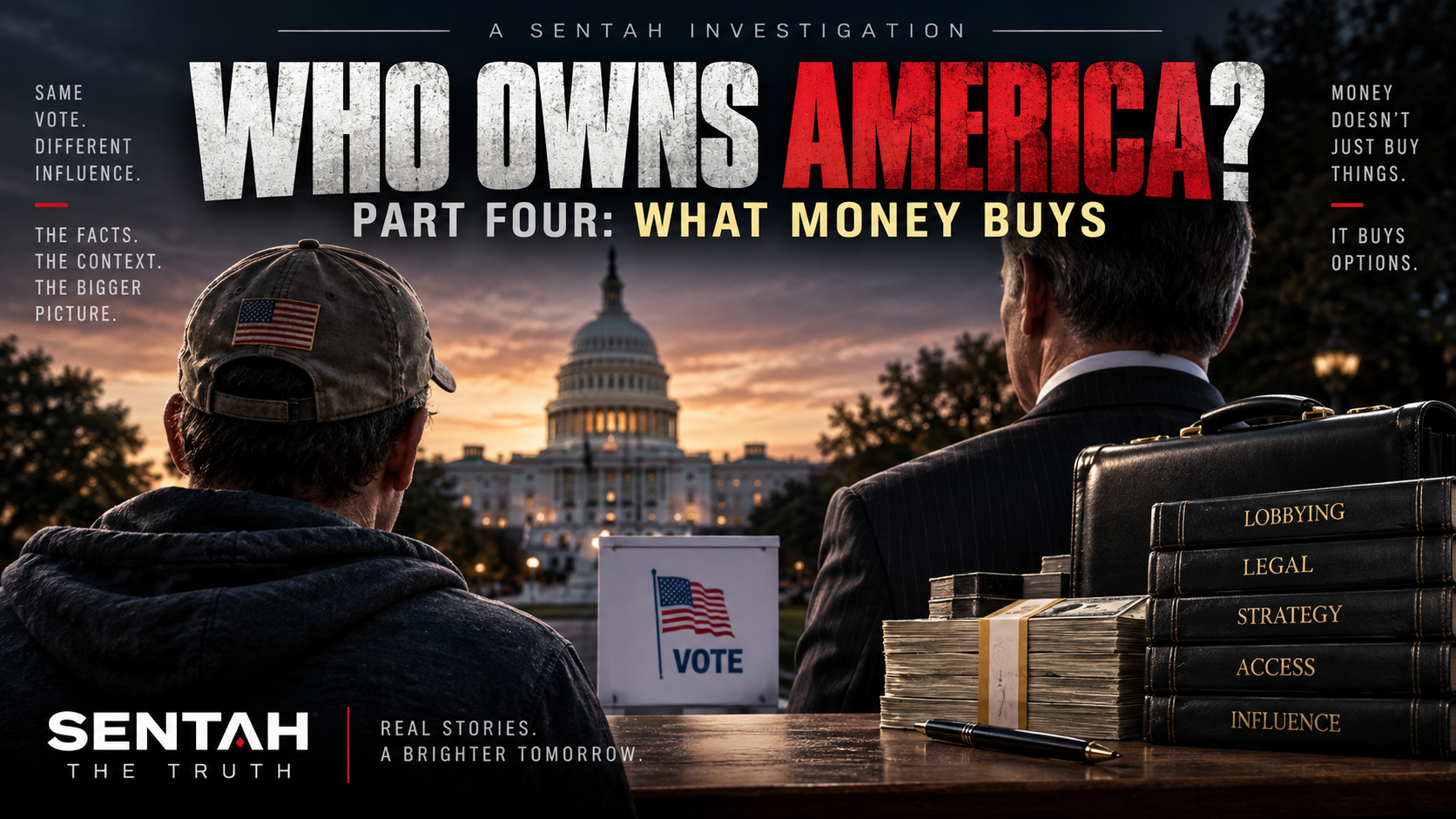
Everybody gets one vote.
Jeff Bezos gets one.
Elon Musk gets one.
Your neighbor gets one.
You get one.
On Election Day, at least on paper, that’s about as equal as America gets.
Then Election Day ends.
And money gets considerably more interesting.
Over the first three parts of this series, we followed the money.
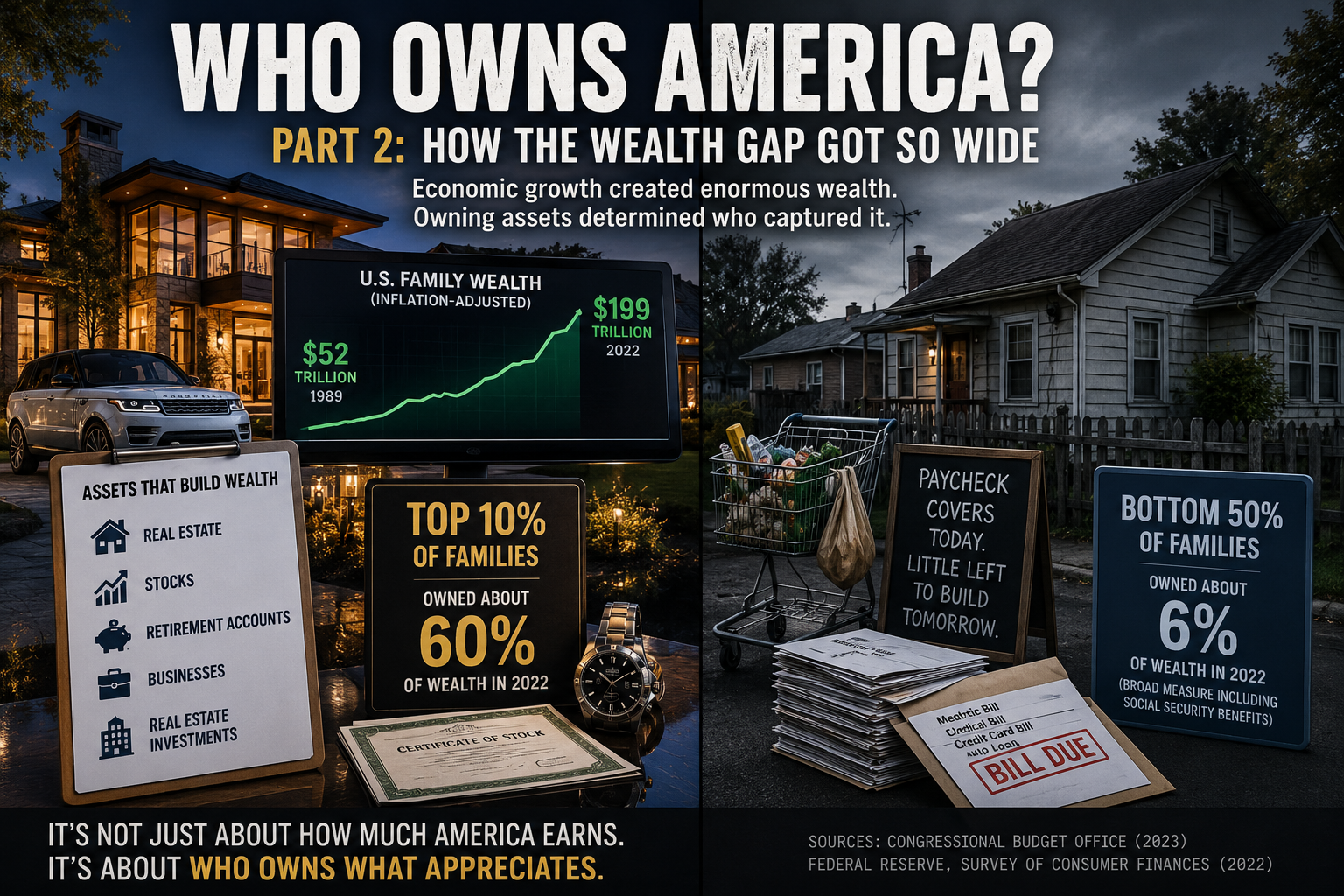
We looked at what Americans actually own, how concentrated that wealth has become and some of the forces that helped create the gap.
That leaves one question.
What happens after the wealth accumulates?
Because there are only so many houses you can live in.
Only so many cars you can drive.
Eventually, money stops being about buying things.
It starts buying options.
And in politics, options matter.
No, a billionaire cannot simply buy a senator
Let’s get the cartoon version out of the way first.
A wealthy donor cannot legally walk into a senator’s office, slide $10 million across the desk and say:
“I’d like the tax bill with extra deductions, please.”
Direct contributions to federal candidates are limited.
For the 2025–26 election cycle, an individual can give a federal candidate committee $3,500 per election.
That’s real money.
It is also pocket change to a billionaire.
But that isn’t the end of the system.
It’s barely the beginning.
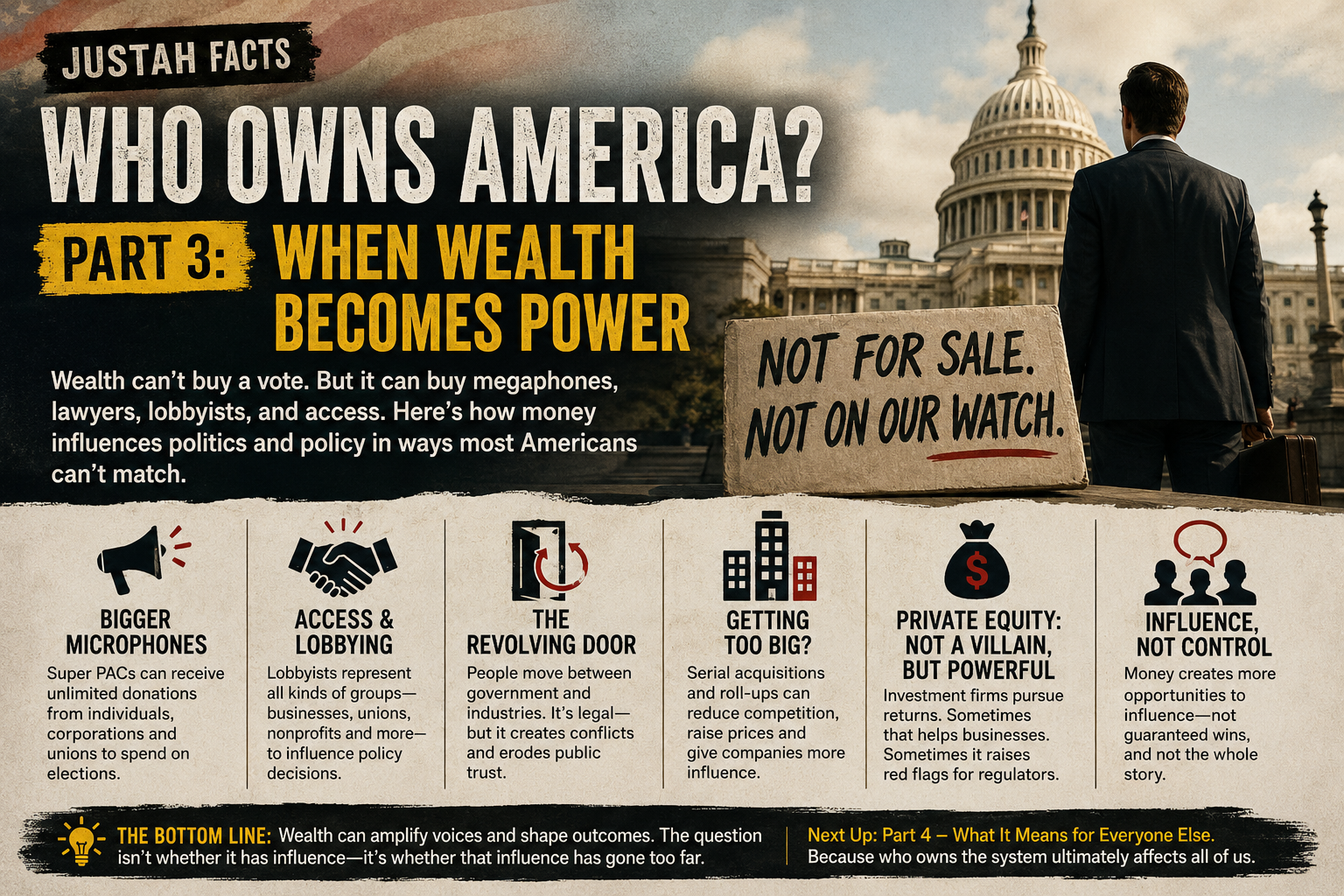
Super PACs can accept unlimited contributions from individuals, corporations, unions and other political committees. They cannot legally coordinate their independent spending with the candidate they support, but they can spend enormous amounts advocating for or against candidates. (FEC.gov)
During the 2024 federal election cycle, presidential candidates spent about $1.8 billion.
Congressional candidates spent about $3.7 billion.
Political parties spent roughly $2.6 billion.
PACs spent about $15.5 billion.
And reported independent expenditures alone reached approximately $4.4 billion. (FEC.gov)
Apparently democracy requires a fairly substantial advertising budget.
Money doesn’t have to buy the vote
This is where the argument usually gets stupid.
One side says money corrupts politics.
The other responds that campaign contributions don’t prove anybody changed a vote.
Both statements can be true.
Because influence doesn’t have to look like this:
Donor gives politician money.
Politician presses “YES.”
Transaction complete.
Politics isn’t a vending machine.
Influence can happen much earlier.
Which candidate becomes viable?
Who can afford television advertising?
Who gets professional opposition research?
Who has lawyers ready when a regulation is proposed?
Who can hire former lawmakers or senior staffers to make a phone call?
Who gets a meeting?
Whose study lands on a congressional desk?
Which issue gets discussed for three years until eventually it becomes legislation?
And perhaps most importantly:
Who can afford to lose today and come back tomorrow?
Money doesn’t guarantee an outcome.
It buys more swings at the bat.
There are levels to being heard
Imagine you have a problem with a federal regulation.
You can email your member of Congress.
Maybe call the office.
Perhaps somebody answers.
You can attend a town hall.
You can write a letter.
You can even fly to Washington if you have the money and time.
Now imagine you’re an industry with billions of dollars at stake.
You can still write the letter.
You can also hire a lobbying firm.
And an attorney.
And an economist.
And a public-relations company.
And a former congressional staffer who knows exactly which office to call.
You can commission research.
Build a coalition.
Fund advertising.
Track legislation.
Meet with regulators.
Testify before committees.
And do it again next week.
Those aren’t the same political tools.
Pretending they are because both sides technically have the right to speak is like saying everyone has an equal chance at the Indianapolis 500 because we’re all legally allowed to drive.
Technically true.
My minivan remains unlikely to win.
Does that actually change policy?
This is where we have to be careful.
A widely cited 2014 study by political scientists Martin Gilens and Benjamin Page examined 1,779 federal policy questions from 1981 through 2002.
Their analysis found that economic elites and business-oriented interest groups had substantial independent relationships with policy outcomes, while the preferences of average citizens showed little or no independent effect once the preferences of other groups were taken into account. (DOI)
That’s a pretty dramatic finding.
It’s also not the final word.
Other researchers challenged parts of the methodology and argued that the original study may have underestimated the influence of middle-income Americans. One critique found that average Americans got their preferred outcome roughly as often as elites did in cases where the groups disagreed and warned against treating the study as proof that America is simply an oligarchy. (Sage Journals)
Good.
That’s what research is supposed to look like.
Someone makes a finding.
Someone else tries to break it.
So we don’t need to declare:
THE RICH CONTROL THE GOVERNMENT.
The evidence doesn’t require that leap.
The narrower conclusion is enough.
People with enormous resources have political tools that ordinary Americans do not.
You can argue about how much those tools affect the final outcome.
It’s considerably harder to argue that the tools don’t exist.
And wealth is very concentrated
This brings us back to where the series started.
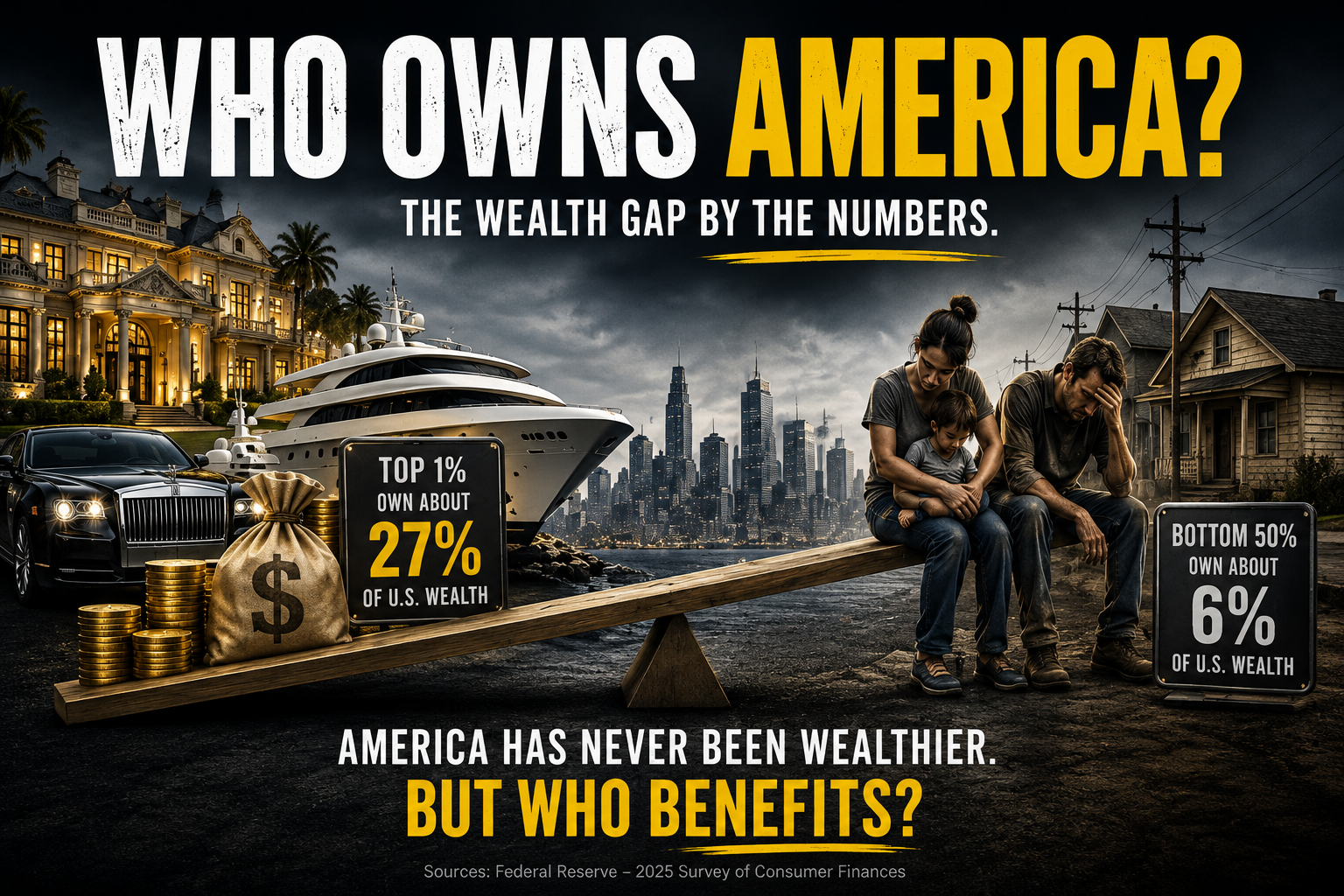
According to the Federal Reserve’s latest Distributional Financial Accounts, in the first quarter of 2026 the top 0.1% of households held about $25.1 trillion in wealth.
The next 0.9% held about $30 trillion.
The bottom half of the country held about $4.3 trillion. (Federal Reserve)
Read that again.
The top one-tenth of one percent held nearly six times as much wealth as the entire bottom half of American households.
That doesn’t mean every wealthy American wants the same policies.
They don’t.
Rich Democrats disagree with rich Republicans.
Technology billionaires disagree with oil executives.
Wall Street sometimes disagrees with manufacturing.
Business owners fight other business owners.
There is no secret billionaire group chat where everyone decides what Congress will do Tuesday morning.
But enormous wealth creates enormous capacity.
And capacity can become influence.
Wealth also determines what kind of wealth you own
There is another detail hiding inside the Federal Reserve numbers.
For the bottom half of Americans, housing and consumer assets make up much of what they own.
At the very top, the picture looks very different.
The top 0.1% held about $13.3 trillion in corporate stocks and mutual-fund shares in early 2026 and another $4.7 trillion in unincorporated businesses.
The bottom half held roughly $590 billion in stocks and mutual funds and about $170 billion in unincorporated businesses. (Federal Reserve)
That matters because ownership isn’t passive.
If you own a house, you own a house.
If you own a substantial piece of a corporation, you own part of something that employs people, hires lobbyists, purchases advertising, contributes to trade associations and interacts with government.
Money can produce more money.
Ownership can produce more ownership.
And economic power can create opportunities for political power.
None of that requires a conspiracy.
Compound interest doesn’t require one either.
This isn’t a Republican story
Nor is it a Democratic one.
Both parties raise enormous sums.
Both court wealthy donors.
Both benefit from outside spending.
Both operate inside the same campaign-finance system.
The wealthy themselves aren’t a political party either.
Some spend heavily to elect Republicans.
Others spend heavily to elect Democrats.
Some hedge their bets.
That’s why reducing this to “Republicans are owned by billionaires” or “Democrats are controlled by elites” misses the larger story.
If the system rewards money, eventually everyone who wants to win learns how to raise it.
You don’t have to like the game.
You still have to play on the field.
But ordinary people aren’t powerless
This matters too.
Money loses elections.
Billionaires back candidates who get destroyed.
Lobbyists fail.
Corporations spend millions and watch legislation they oppose become law.
Voters surprise everyone.
Grassroots movements organize.
Small donors add up.
Public opinion changes.
Politicians occasionally discover principles.
It happens.
We shouldn’t replace one simplistic story—
everyone has one vote, therefore everyone has equal political influence
—with another—
the rich have money, therefore voters don’t matter.
Neither survives contact with reality.
Millions of ordinary voters absolutely possess political power.
The question is whether that power is distributed as evenly between elections as it is inside the voting booth.
Follow the money all the way to the end
We started this series asking a seemingly simple question:
Who owns America?
The answer was never going to be one number.
America’s wealth is highly concentrated.
That concentration developed through a mixture of wages, asset ownership, housing, business ownership, inheritance, tax policy and decades of compounding.
And wealth does more than buy comfort.
It buys time.
It buys expertise.
It buys organization.
It buys access.
It buys the ability to make your argument louder, longer and more often than most people ever could.
None of those guarantees that you win.
But if two people walk into a political fight and one has an email address while the other has a lobbying firm, three lawyers, an economist, a Super PAC and enough money to keep going for 20 years…
I’m comfortable letting you decide whether they’re entering that fight with equal influence.
Sources
Federal Reserve Board — Distributional Financial Accounts, first quarter 2026.
Federal Election Commission — Statistical Summary of 24-Month Campaign Activity for the 2023–2024 Election Cycle; 2025–2026 contribution limits; guidance on Super PAC contributions.
Martin Gilens and Benjamin I. Page — “Testing Theories of American Politics: Elites, Interest Groups, and Average Citizens,” Perspectives on Politics, 2014.
Omar S. Bashir — “Testing Inferences about American Politics: A Review of the ‘Oligarchy’ Result,” Research & Politics, 2015.