If you’re on AHCCCS and you’ve heard that Medicaid “work requirements” are coming, there are two things worth knowing before we go any further.
Yes, they’re real.
No, they don’t apply to everybody.
That second part matters, because “Medicaid work requirements” is exactly the kind of phrase that can turn into “Everybody on AHCCCS better start sending in pay stubs” by the time it makes its third trip through Facebook.
That isn’t what the rule says.
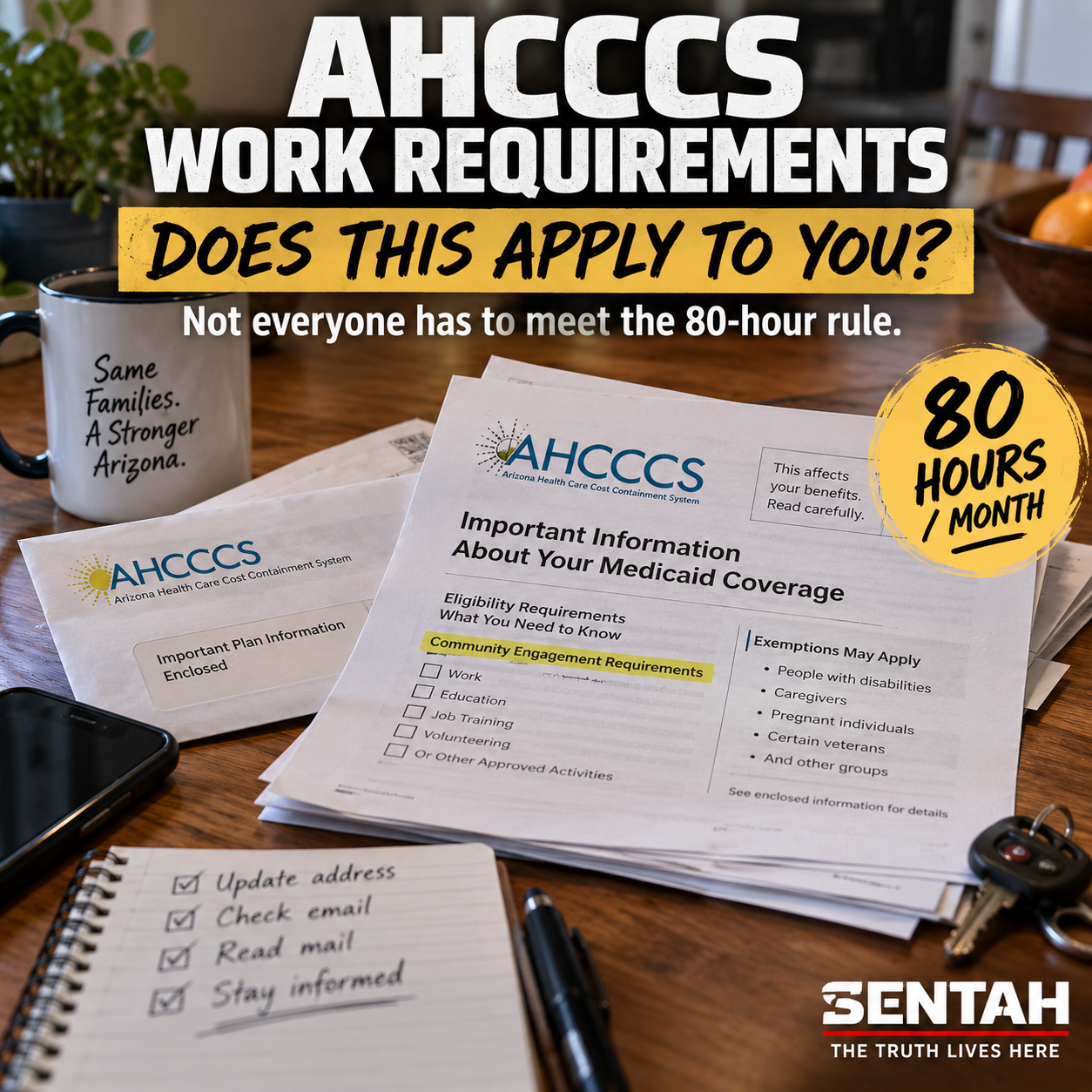
Beginning January 1, 2027, certain adults covered through Medicaid expansion will have to show they are working, going to school, participating in job training, volunteering or doing another approved activity for at least 80 hours a month.
There’s also an earnings route: someone subject to the requirement can satisfy it by earning at least $580 during the month.
AHCCCS says nearly 417,000 Arizonans could potentially be affected.
That’s a lot of people.
It’s also nowhere near everybody on AHCCCS.
So who are we actually talking about?
AHCCCS calls the group “Expansion Adults.”
Because apparently “the adults this applies to” wasn’t government enough.
In plain English, we’re generally talking about adults ages 19 through 64 who receive Medicaid through the expansion population and who don’t fall under one of the exemptions established in federal law.
Children aren’t subject to the requirement. Adults 65 and older aren’t either.
And then we get to the part that matters quite a bit for disability families: there are exemptions.
A lot of them.
Caregivers are one of them
Federal law includes an exemption for a parent, guardian, caretaker relative or family caregiver caring for a dependent child age 13 or younger or a person with a disability.
Read that last part again if you need to.
If you’re caring for a person with a disability, the law recognizes that caregiving itself may put you outside the group required to separately prove 80 hours of work, school or volunteer activity every month.
For Arizona disability families, that is not a minor footnote.
But there’s still an important question AHCCCS has to answer:
How do you prove it?
The exemption exists. Arizona is still developing the process people will use to claim and document exemptions.
And anybody who has dealt with a government benefits program knows those are two very different sentences.
A protection can exist on paper.
If nobody understands which box to check, which form to submit or which document AHCCCS wants, that protection becomes considerably harder to use.
People with disabilities may be exempt too
The rules also include exemptions for people who are medically frail or have certain serious medical needs.
That includes people who are blind or disabled under federal standards, people with certain disabling mental-health conditions and some people with substance-use disorders.
Veterans with a total disability rating are also among the exempt groups.
But here again, there’s a difference between having a disability and AHCCCS having whatever information it needs to recognize that exemption under this particular rule.
That implementation piece matters.
It may turn out to be simple.
It may not.
Anyone who has ever received a letter from a government agency beginning with “According to our records…” probably knows which direction this paragraph could go.
Who else is exempt?
There are several other groups.
They include people who are pregnant or within 12 months after pregnancy, certain former foster youth, qualifying American Indian and Alaska Native members, people participating in certain substance-use treatment programs, and some people already meeting similar requirements through programs such as SNAP or TANF.
There are also exemptions involving incarceration or recent release, and temporary hardship situations such as hospitalization, federally declared disasters or unusually high unemployment.
You don’t need to memorize all of that.
The important takeaway is much simpler:
Having AHCCCS does not automatically mean you have an 80-hour work requirement.
That’s the sentence worth remembering.
What counts toward the 80 hours?
For people who are subject to the requirement, qualifying activities can include paid employment, education, job training, workforce programs, community service or volunteering.
They can also be combined.
And again, someone can satisfy the requirement through monthly earnings of at least $580.
What Arizona still has to build is the system for actually reporting all of this.
That may sound like the boring administrative part of the story.
It isn’t.
Congress can write “80 hours” into a law. Eventually somebody has to build the website, send the notices, decide what documentation counts, process the exemptions, deal with people whose information doesn’t match and figure out what happens when something goes wrong.
That’s where policy stops being a sentence in Washington and starts becoming somebody’s Tuesday afternoon.
And there’s another change coming
Certain Medicaid expansion adults will also have to renew their AHCCCS eligibility every six months instead of once a year beginning in January.
Now put the two changes together.
For people subject to the new requirements, there will be more frequent eligibility checks while the state is also implementing a new system for documenting work activities and exemptions.
That doesn’t automatically mean people will lose coverage who should remain eligible.
But every additional notice, deadline and piece of paperwork creates another place where something can go sideways.
Wrong address.
Missed letter.
Document never received.
Form filled out incorrectly.
A person who qualifies for an exemption but doesn’t realize AHCCCS needs something from them.
Anyone who deals with disability services probably doesn’t need an analogy here.
So what should you do right now?
Not much.
Really.
AHCCCS has specifically said the new work requirements are not in effect yet and members do not need to start reporting hours now.
If the new requirements apply to you, AHCCCS says it will contact you.
What you can do now is almost annoyingly simple: make sure AHCCCS has your current mailing address, phone number and email address.
And open the mail.
I know. Groundbreaking advice from Sentah the Truth.
But the letter sitting unopened on the kitchen counter stops being junk mail pretty quickly when it contains the instructions for keeping your health coverage.
AHCCCS has also launched KeepMyAHCCCS.com as a central place for information about the coming changes, and the agency says more Arizona-specific guidance will be released as implementation gets closer.
The law is written. Now comes the part that affects people.
There will be arguments over whether Medicaid work requirements are good policy, bad policy or somewhere in between.
We can have that argument another day.
Right now, the more useful question for an AHCCCS member is:
Does this apply to me?
For many people, the answer will be no.
For others, the answer may be: yes, but you qualify for an exemption.
And for some of the nearly 417,000 Arizonans AHCCCS says could be affected, the answer will be yes — which means they’ll eventually need to understand exactly what Arizona requires them to report and when.
Nobody needs to panic in September about a rule that begins in January.
But people do need clear information before January gets here.
Because Medicaid policy is complicated enough when you understand it.
Nobody should lose health coverage because the explanation was harder to understand than the rule.