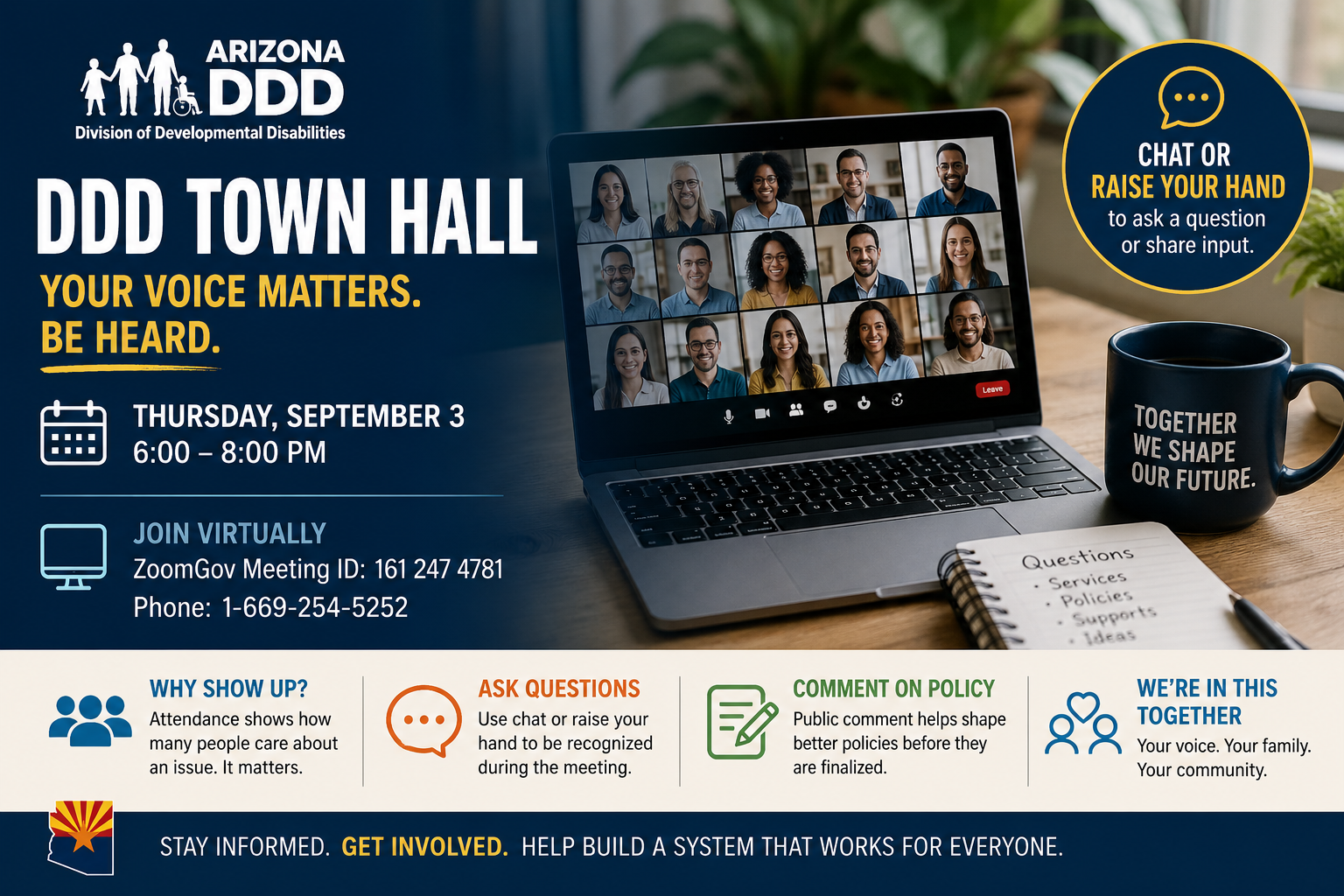
The Arizona Division of Developmental Disabilities will hold its monthly Town Hall on Thursday, September 3, from 6 to 8 p.m.
DDD says its regularly scheduled Town Halls are designed both to provide information about Division initiatives and other news and to hear from members, families and providers about issues important to them.
The published agenda for Thursday is broad, listing “Updates” and “Announcements.” That means families should not assume any particular issue will be discussed unless DDD announces additional agenda details.
But with significant policy work underway across Arizona’s developmental-disability system, there is plenty for families to pay attention to.
How to attend
The meeting is virtual through ZoomGov.
Date: Thursday, September 3, 2026
Time: 6–8 p.m.
Meeting ID: 161 247 4781
Phone option: 1-669-254-5252
Join the DDD Town Hall:
Use the official DDD meeting page below for the current ZoomGov access information and any last-minute updates.
People who need a reasonable accommodation can contact the DDD Customer Service Center at 1-844-770-9500, option 1. DDD recommends making accommodation requests as early as possible.
You don’t have to be an expert to participate
DDD Town Halls aren’t only for providers, lobbyists or people who spend their days reading state policy manuals.
They are for members and families, too.
During DDD Town Halls, participants are generally muted when entering the meeting. DDD’s Town Hall instructions have provided two ways for participants to ask questions or provide input: submitting a question through the Zoom chat or using the Raise Hand feature under Reactions and waiting to be called on.
The precise moderation format can vary from meeting to meeting, so participants should listen for instructions from DDD at the beginning of Thursday’s meeting.
And even if you don’t want to speak, there is still a reason to log in.
Why simply showing up matters
There is a practical pecking order when government agencies determine where attention is needed.
Attendance is one of the signals administrators can see.
Forty people attending a meeting about an issue sends a different message than hundreds of members, parents, caregivers and providers showing up.
That doesn’t mean attendance is a vote, and a large Zoom audience doesn’t automatically determine policy.
But it does tell administrators something important:
People are paying attention.
When large numbers of people participate, it demonstrates that an issue matters to a significant part of the community. When those same families ask questions, submit comments and describe how policies affect them in the real world, that signal becomes stronger.
You don’t have to give a speech for your presence to count.
Public comment is another way to be heard
Town Hall participation and formal public comment are not the same thing.
DDD develops and revises policies governing how the Division operates and delivers services. When proposed policies are placed out for public comment, members of the public have an opportunity to review the language and tell the Division what they think before that process is completed.
That matters.
Families and providers are often the people who discover how language written on paper will actually work at a kitchen table, during a planning meeting, inside a group home or while trying to arrange services for someone with a developmental disability.
A proposed policy may contain confusing language, create an unintended consequence, overlook an unusual circumstance or simply work differently in practice than policymakers anticipated.
Public comment gives people affected by those policies an opportunity to point that out.
DDD says it welcomes comments and suggestions and currently has multiple proposed policies open for public comment through September 11, 2026.
Among the areas currently represented are behavioral-health case management; support and rehabilitation services for children, youth and young adults; employment-service requirements; DD-Only eligibility support-coordination standards; service-plan monitoring and reassessment; provider monitoring; quality management; and adult emergency and routine dental services.
DDD provides both clean and tracked-change versions of many proposed revisions so readers can see what is being changed.
View policies currently open for public comment and submit a comment:
https://des.az.gov/services/disabilities/developmental-disabilities/policies-and-rules
DDD prefers comments submitted electronically through its DDD Policy Public Comment Submission Form, which is linked on that page.
When commenting on specific policy language, DDD asks commenters to identify the document and line number involved. That helps the Policy Unit understand exactly what language the commenter wants reviewed.
What should families listen for Thursday?
DDD has not published a detailed issue-by-issue agenda for the September 3 meeting beyond “Updates” and “Announcements,” so it would be premature to say exactly what Division officials will discuss.
There are, however, several major issues currently moving through Arizona’s developmental-disability system that families may want to listen for.
Among them are continuing changes involving the Home and Community Based Services Needs Tool (HNT) and Extraordinary Care Rate (ECR).
The timeline surrounding HNT/ECR has continued to evolve. Current state information anticipates another formal public-comment period beginning in mid-September, with policy work continuing this fall and implementation of the new HNT/ECR policies currently planned for December 1, 2026.
Families may also want to listen for updates involving services, providers, planning meetings, assessments and other policy or operational changes affecting DDD members.
If an issue important to you isn’t discussed Thursday, DDD also provides a Public Town Hall Topics form where members of the community can suggest subjects for future Town Hall presentations.
The system works better when the people affected by it participate
Arizona’s developmental-disability system is complicated. Most families don’t have time to monitor every policy revision, rulemaking notice or government meeting.
They’re busy doing what families do — working, getting kids to school, coordinating therapies, dealing with providers, attending planning meetings, managing medications and taking care of the people they love.
But decisions made in government offices eventually arrive at their front doors.
Town Halls and public-comment periods are opportunities to get involved before those decisions simply become another policy families have to live with.
You don’t have to understand every acronym.
You don’t have to speak.
You don’t have to agree with everyone else in the room.
Sometimes the first step is simply being there.
DDD Town Hall: Thursday, September 3, 6–8 p.m.